Showing posts with label Art and Faith. Show all posts

March 22, 2015

When "Almost, Maine" almost wasn't; a playwright asks WWJD

When I first joined the theatre faculty at Lee University I chose John Cariani’s (now very popular) Almost, Maine as the first play I would direct. 

It’s an alternately sweet, sad, and funny play about love.  About finding it, losing it, being surprised by it, and realizing when it’s passed you by.   The play is made up of several stand-alone vignettes featuring the various residents of a rural stretch of Maine.  Exactly the kind of play an audience of Lee Theatre production would enjoy.  Oh, and also there is a scene in the play where the people who find love both happen to be men. 

Lee is a Christian liberal arts university in a very conservative region.  So, I knew that we could only produce the play if we omitted that particular scene.  It’s sweet and, compared to virtually any other television or film depiction of gay relationships, it is very innocuous.  Still, doing the scene would be so controversial that the rest of the play would be overshadowed.  That’s a waste of a lot of time and energy on our part, if the audience doesn’t even notice the other 90% of the play. 

However, we knew it would be both immoral and illegal to cut the scene without the playwright’s permission. Unfortunately, I was running out of time, if I didn't get permission pretty quickly it would be back to the drawing board in finding an appropriate play for my first production at Lee. I got lucky and found the email address of the playwright, Mr. John Cariani. 


I largely expected a “no”. In fact, I probably would’ve said no had the tables been turned.  But instead, we received the following very gracious reply.

I want you to know how much I appreciated your e-mail. "They Fell" has been cut from the play so many times--and I have learned about the cut after the fact. So uncool. But your wonderful e-mail--made me feel so...respected! It meant so much. I appreciate your kind words about ALMOST, MAINE. And I really do feel for you and Catherine and Christine. I am so sorry you have to deal with stuff like this. It's so lousy.

So...my initial reaction to your request was NO WAY! But--when I thought about the lousy position you're in...well, I decided that saying NO WAY is just mean. Fighting hate with hate, kind of. And that's not cool. So I say--go for it. I don't want to be a hater. I think omitting "They Fell" makes ALMOST, MAINE a lamer play. But--I understand your position, and feel like the rest of the play should be heard! So...here's me granting you permission to do the play without "They Fell." With one caveat. I would like there to a note in the program from me. It's below.

October 2, 2010
Greensboro, North Carolina

Dear Audience Members,
Lee University's production of ALMOST, MAINE is not being performed in its entirety. One scene, called "They Fell," has been omitted. When I was initially approached about allowing ALMOST, MAINE to be performed without this scene, my response was, "Absolutely not." "They Fell" is a story of two people who literally fall in love. I think it is an interesting examination of love, of being true to your heart, and to yourself. To me, redacting the scene lessens the impact of ALMOST, MAINE as a whole.

Initially, I was very angry that anyone would even consider cutting the scene. However, good decisions are never made in the heat of the moment. As I thought about the request, I realized that perhaps I was being intolerant, imposing my values on others. I was also making my decision from a place of anger and that's just no good. I'm a Christian, so I asked myself:  WWJD?  He'd probably allow the production so that at least part of the message of the play would be imparted. So, that's what I decided to do. "They Fell" was never written to inflame or offend, it was simply to tell a story--a love story-- and I don't think that is wrong. I hope that after you see this production of ALMOST, MAINE, you will seek out a copy of the full script and read "They Fell."

I hope you enjoy the show.

Sincerely,

John Cariani
"But I say to you, love your enemy and pray for those who persecute you,so that you may be like your Father in heaven, since he causes the sun to rise on the evil and the good, and sends rain on the righteous and the unrighteous."--Matthew 5:44-45

If you think any of this is a bad idea, please let me know.
Thanks for your kind words and for doing what you do. Boy--theatre seems so important at places like Lee. Fight the fight!

With great respect,

John

[Joyful music] We were of course stunned.  We couldn’t believe his response.  When we went to our university’s administrators with his reply, they were thrilled!  They told us to go ahead and do the play and publish the playwright’s note in the program, but... to cut the Bible verse.  [Record scratch] They believed it was combative, and to be honest, I could see their point.  This was going to be difficult.  Now I had to write back to this man who has done a very selfless thing by considering our audience above his own written work, and ask if I could cut the BIBLE verse, of all things, from his letter. 

Most of my letter was very positive.  I thanked him for his permission and wrote about how excited I was about the instructive possibilities of this situation for our students and audiences.  And then I included this:

You asked me if I thought any of it was a bad idea.  And as you can tell from my gushing thus far, I think it's a very GOOD idea.  There's one thing I would like to mention.  You quote a Bible verse at the end of your program note.  And while I understand its appropriateness to the situation, I am concerned that some reading it might interpret words like "persecutors" and "unrighteous" as combative in this context.  I think anything that smacks of an "us" vs. "them" sentiment undoes all the good that can happen here.  I would recommend keeping the letter exactly like it is and either removing the verse or choosing another one.  I don't think you meant to say that Lee audiences are "the enemy", clearly you're talking about prejudice and hate.  But I wouldn't want anyone to think you're applying those labels onto the very people reading the note.

It was several days before I heard anything in response. I thought we had lost him. We’d asked too much.  I was reading other plays in case I had to do a last minute switch.  But finally, he replied with this: 

Well... I think this is all extraordinary. Can we talk? Call me: [his cell phone number omitted]. I am a little busy with my new play and can't properly respond to this in an e-mail--just don't have the time--because I have a deadline!  But--let's cut the Bible verse. That was a barb on my part. No need for it. Or any verse. I don't want to demonize--and that's what I was doing. No good. Good catch. So--the letter--without the verse. Perfect.

This dialogue is so great. Because it's a DIALOGUE! I bet you guys get screamed at all the time for asking to modify plays...and you're all Christians who believe in the power of theatre! And...I wish more playwrights would just revolt from within. Disguise their points a little more. And...I wish more theatre people in NYC believed in the power of God! And I'm not real "Goddy."

A few days later, I did call him and we had a great chat.  He told me how hard it was for him as a New York City playwright to deal seriously with faith in his plays. He wasn’t trying to write plays about Jesus, but he felt like no one would take any character seriously if he/she was a person of faith.  And as I shared some of the struggles we had at Lee, we realized we had inverse versions of the same problem.  I often struggled to serve art well in a world filled with religious people, and he often struggled to serve religion well in a world of artistic people. 

At the end of the conversation, I felt truly blest. In this dialogue, I encountered God.  I was blessed by the experience.  In this unexpected, respectful connection, I told Mr. Cariani that I sensed God's presence and he voiced a similar notion. I told him that I believe God exists and manifests himself most clearly in the spaces between people. And to put it simply, in our connection, God showed up.

I am in the connection business.  In my art, in my teaching, I strive to help people connect people.  Audiences to performers, students to playwrights, designers to directors, etc.  As I go forward I will strive to remember the humility of my friend, Mr. Cariani when I want to make those connections God-filled ones.

Ultimately, the play was produced and was a big crowd pleaser.  Best of all, our audiences, our cast and crew, and the director learned a lesson in grace from a playwright who thinks he's not real "Goddy".

Cast of Almost, Maine at Lee University - 2010


Let us love one another, for anyone that loves is borne of God and knows God. (no one asked me to cut this verse)


**Please note:  Anyone reading this article should not assume that Mr. Cariani would grant this permission to any such request.  I would not be willing to speak on his behalf regarding any special requests regarding his work. And you should contact the playwright or his agent. 

March 11, 2015

In defense of the The Fence (Tim Minchin)

In my last post  about talking to my kids about life's big questions, I mentioned how I've never been very comfortable with the simple answers.

It's because, I, like most of my generation, am suspicious of any narrative or explanation that seems to nicely categorize or compartmentalize life into easily digestible bites.  It's part of a wide spread reaction against binaries.  My generation and the one after me likes to challenge efforts to neatly organize the world into one group or another, and we're particularly fond of culture that examines the stuff that falls in between two categories or neither or both.  It's why you'll see so much art dedicated to the stories of people, ideas, or events that challenge binaries like:  truth vs fiction, memory vs. history, high art vs. low art, gay vs. straight, good vs. evil, etc...  

I don't say it nearly as well as this comedian/musician named Tim Minchin.  He's an eccentric, extremely intelligent, and clever guy. His lyrics can be inappropriate for younger ears, but this song is pretty mild in the language department.  You should give it a listen.  Here are the lyrics to the chorus:  
This is a song in defense of the fence
A little sing along, an anthem to ambivalence
The more you know, the harder you will find it
To make up your mind, it, doesn't really matter if you find
You can't see which grass is greener
Chances are it's neither, and either way it's easier
To see the difference, when you're sitting on the fence


January 13, 2008

Church Theatre NOT Cutesy Church Skits

I've been pretty immersed in the intersection of the Church and the Arts for some time now. I have directed a large church's Drama Team. I have taught theatre at a Christian School. And I have written articles about arts and faith and the church drama team's purpose.

And yet, I have yet to be involved in a situation where a church is making real theatre art that isn't ultimately limited to the service of illustrating the sermon. This is an okay use of drama, although perhaps a bit limited and not one I am interested in creating.

I had recently resigned myself to the idea that REAL theatre could only exist outside the church (even if the intended audience is Christians). There are just too many forces exerted by a traditional church congregation that make artistic exploration of truth near impossible.

But... I just found a theatre that's doing it! It's called the First Pres Theatre in Ft. Wayne, IN (of all places).

Their website is a bit sparse, but all indications are that they're doing real theatre and have been doing so for 30 years! They've tackled challenging works (that might not sit well with church-folk) including Equus, Jesus Christ Superstar, ART, Agnes of God, The House of Bernarda Alba, Doubt, and The Shadowbox. Their purpose statement page is downright inspiring. Here's a taste:
Strong dramatic presentations are a revealing test of those who call themselves Christians, especially when the presentations occur in a church theater. They test whether we, as Christians, really believe what we say we believe. If we have the faith that we say we have, we can expose ourselves to a cynical play without becoming cynics, to a nihilistic play without becoming nihilists. And we will not need first to have someone "safe" explain away the pain of the recognition and make just a nice little logical exercise out of the play.

The church is only ready for religion, only ready for drama, when it can open itself to the implications of dramatic revelation; when the congregation can accept the world of the imagination and can risk being excited, risk being frightened, risk being changed. Such risk is near the very heart of the Christian message.

I got a chill, did anybody else? Anybody?

May I just offer a THANK YOU to 1st Pres Theatre of Ft. Wayne. Thanks for encouraging me in my belief that Christians CAN encounter theatre art and that the Church can have a role in that exposure. I know you've been doing it for a while, but may God bless your every production for many years to come.

May 22, 2007

Imagine; a Vision for Christians in the Arts by Steve Turner


I'm doing my assigned summer reading for my first class. (I'm going back to school to get my MFA in Directing)

The book is entitled Imagine; a Vision for Christians in the Arts by Steve Turner.

I've read any number of books on this topic. Heck, I've even written a few articles on the stuff and lead workshops on "God and the Arts."

So, I largely expected this to be an exercise in head-nodding. Not the "I knew that already" head nod, but the "Yes, yes, yes, that's what I've been preaching!" Even that would've been a valuable exercise. To be reinforced in my beliefs and passions is a noble endeavor, but the book has done much more.

The author is an ex-fundamentalist, ex-hippie (although its a lower case ex on the hippie part) who went on to become a poet and music critic. He was at L'Abri when Francis Schaffer was just getting things started there. And in this books he does two things that greatly impress me.

1. He's methodical. It's tough to find somebody who gets the arts that can think in highly structured argumentation. Try reading Madeline L'Engle's Walking on Water. It's like Philosophical Linguini, delicious and satisfying, but not fun to untangle. He has well gathered lists of the arguments often raised against the arts, and careful responses to each. He lists interesting differences between the evangelical stance toward the arts and the catholic position. And he nicely lists the possible causes for the variance.

2. He's all-encompassing. His grasp of the problems and power of the arts is not confined to his specific field of artistic vocation. He so accurately portrays the arguments posed against the actor, director, musician, sculptor and novelist one starts to wonder if he hasn't lived half a dozen lives, each as a different variety of Christian artist who has had to endure his brothers' and sisters' bitching about his unique call in the Kingdom.

I'm only a third of the way through the book and while it doesn't give off the fire of L'Engle's ethereal musings or Franky Schaffer's empassioned rant (Addicted to Mediocrity) it is like someone neatly stacking the wood meant to fuel those fires.

We need wood stackers as much as we need fire starters.

May 18, 2007

Rewards of the Vocational Variety

I recently had my Year-End Theatre Bash, a party for the casts and crews of both productions we’ve done during the school year, and the improv team. The kids surprised me at the end by having a time where they each shared something about how the theatre department or I had impacted them in my time here.

WOW!

As they each spoke (about two dozen kids), I was hearing the passions of my heart spoken in their own words.

“…I understand how God is in the midst of the arts…”

“…theatre is so powerful…”

“…you helped me find out who I am and really like that person…”

It was about the greatest gift they could’ve given me. After the party one of my students came up to me and said “You always say things about me that are only a little bit true. And then I work really hard to make sure they are very true.”

I wasn’t immediately impacted by this statement. But the more I thought about it, the more I realized what a compliment that was. In this boy’s life, I saw the best in him and called attention to it, and it inspired him to be more of his best self. That was never an intentional goal of mine, but I’m going to work really hard to make sure it is from now on.

March 23, 2007

Theatre - What Church Should Be

When I went to Baylor to interview for my graduate assistantship the faculty recommended I poke my head in for the workshops occuring that Friday afternoon.

The undergrad directing class would be presenting their Shakespearean scenes and, they said, it'd be a good chance for me to get to experience a class in action.

To be perfectly honest, my primary reason for showing up was to impress my eagerness upon the professors of the class, who were a part of the committee that would give me the thumbs up or down.

I expected 12-15 students gathered in the black box theatre space to see these scenes. So I was quite surprised to arrive to a packed house of 150 undergrads, grads and professors.

Students and faculty had come to support their friends and students, and to see what other classes were doing. The place was abuzz with enthusiastic greetings and shouts from the house to the catwalks as students acknowledged their friends who were assigned to tech for the impending scenes.

By the time I was seated, a student was announcing the "student of the week" and the "faculty member of the week" for whom everyone applauded. The professor asked if anyone else had announcements. A young man jumped up "I've got two spots left for concessions this week, if anyone's interested in helpoing us out let me know." [The following weeked was the opening of Annie Get Your Gun, a large-scale musical production.] Then, a young woman popped up and added, "And we'll be in the costume shop pretty much all night tonight and a lot this weekend. If anybody can use a sewing machine, we'd be glad for the help."

I was witnessing community.

The professor welcomed everybody, and the director of the first scene gave a quick introduction and reminded us to turn our cell phones off.

Then the lights went down. And like any good blackbox when the lights go down, its dark to a degree that's difficult to describe. Let's put it this way, closing your eyes doesn't impact the visual experience. The music fades up nicely, a smoke machine is effectively adding a misty mysticality to the space, and the lights come up.

There was not a whisper, a murmur or even a cough. The importance of the event occuring before us was palpable. The scene was from one of the less exciting scenes of Julius Ceasar, but I didn't sense I was in a room full of people fulfilling some sort of duty to the art. It didn't feel like the dentist waiting room, where people give half smiles to each other as if to say, "Gosh I dislike this, but... I guess it's inevitable." They were enraptured. And even more amazingly, it wasn't just the sotry that held their attention, but the WORK. The wrestling with this masterpiece was the main event here. How would their peers set their teeth to this piece that they'd all seen attempted and maybe attempted themselves? The room was electric, and it was a love of the art and each other that was conducting the charge throughout the space.

I thought, "this is almost like church." And then I thought, Wait a second! No it's not! I really want to be HERE! Why isn't church like this? Why isn't it a place wear I'm dying to reconnect to the members of my community, where calls to service don't need clever skits or marketing to drum up interest, where worship is approached with a sense of awe, and where the audience/congregation is as enraptured by the people tackling the subject matter as they are the content?

I have no doubt that I'm idealizing the experience to some extent, but I think the point is valid. And perhaps it's more an indictment of my own feelings about church than it is of the Church. I'm certainly not conducting electricity in my sanctutorium (we meet in a school's lunch room) . Where is my reverence? Why do I lack that palpable sense of importance to what's occuring in church?

I don't know the answer to this, but I do know I saw God in those Friday afternoon scene workshops. And I'll be looking for him again there.

November 27, 2006

My personal logo

A freind of mine that's a professional designer created this logo for me when I described to her my idea about "the fourth figure."

The verse (Daniel 3:25) is the moment when Nebuchadnezzar looks into the fiery furnace and sees that where there had once been three men, there are now four. ("And the fourth is shining like a son of the gods.")

This is what I strive for onstage. When we are wokring as an ensemble, like-minded and singularly worshipping God with our talents, I believe He shows up.

Special howdy to friends that I met or saw again at the recent Association of Christian Schools International. I led two workshops on Improv, one on Creative Writing, one on God and the Arts, and one on Film Appreciation. I met so many talented folks with passion for the arts. Good stuff.

August 29, 2006

Top 100 Spiritually Significant Films - 2006

Many of you may know I spend a good deal of time over at www.artsandfaith.com. Which in, my opinion, lives up to its slogan "The best place on the Web for discussion of Christian faith, the arts and much more."

It's more a community than a discussion board. And the minds there humble me. In actual face-to-face discussions people seek me out for opinions and insights; I go HERE to learn.

A&F has put out a list of the Top 100 Spiritually Significant films. They have a long and carefully-conceived nomination and survey process. This list is the result. Lots of films you've probably never heard of here, which, in my opinion, is its strength. This isn't a list rehashing the same films everybody has seen, it's a primer for those who want to engage cinema with real depth.

It's not your typical Christian list. Passion of the Christ made the list, but it's way down at 45. It also contains The Elephant Man, The Last Temptation of Christ, and Crimes and Misdemeanors.

August 21, 2006

Christian High School Play ideas (Safe but not Shallow)

Shows that work for High School (even some Christian High Schools)


I’ve decided to make a sort of clearinghouse of ideas for plays for high schoolers. This is the hardest part of my job. Finding shows that work for my small talent pool and my conservative audiences. My goal is to have this be a place where we can share shows that are “Safe but not Shallow.”

I strongly prefer works of actually literature, not overly cutesy or overly churchy stuff. But I recognize that too much profanity or certain subjects will alienate my audiences.

Please give ideas in the comments and I’ll add them to the list. If you know cast size, quick comments on how elaborate the set is, and a mention of “hot buttons” that may make your show inappropriate for someone else’s theatre mention them.

If you just want to list shows you’ve done or seen done that worked, let me know.


The List

All My Sons - Arthur Miller
5M, 4W, 1m (8-11 yrs old ) Some mild profanity (GD’s, D’s and H’s), a suicide. Very powerful drama about truthfulness.

Harvey -
Mary Chase

6M, 4W one or two very mild profanities – hysterical and meaningful comedy.

Dial M For Murder -
Fredrick Knott
4M, 1W (one extra M) – no profanity, but a murder is attempted on stage and someone dies in the attempt, the bad guy “gets it” in the end

The Foreigner
- Larry Shue
5M, 2W – The funniest play ever made.
A few very mild profanities, one female is pregnant before being married (she and others recognize its not the “best” situation).

Cyrano de Bergerac - Edmond Rostand
many M (12-15), 5-7 W – A great show with a huge cast. The themes are PERFECT for high school or even Jr. High, Language is clean, but may be over some audiences’/casts’ heads.

Judgment at Nuremberg -
Aimee Mann
15 M, 3W – Super powerful courtroom drama about the trials of Nazi War Criminals. No profanity, but discussion of holocaust issues (and footage of it if you choose to show it).

Others with further descriptions coming:
God’s Favorite – Neil Simon
Steel Magnolias – Robert Harling
Cyrano de Bergerac – Edmond Rostand
The Last Nights at Ballyhoo
Antigone – Jean Anouhl
Shadowlands
Afternoon of the Elves
Anne of Green Gables
Welcome to Justice – Dan Buck (write me) J
Talley’s Folley
Arsenic & Old Lace
Fools – Neil Simon
The Nerd – Larry Shue
The Diviners
Our Country’s Good
Beau Jest

April 03, 2006

Mistakes Conservatives Make in Art & Entertainment

Great Article below, even though I don't see them as synonyms you could replace the word "Conservative" with the word "Christian" and its still very true.


Mistake #1: We try to improve art and entertainment from the top-down and the outside-in. For example, when well-meaning people, flush with cash but bankrupt on talent, attempt to “show Hollywood” by creating films that go around proven creative methods, the result is always the same: direct to video, a waste of time and money. Enduring change, meanwhile, comes from the bottom-up (working your way up from the mailroom) and the inside-out (working within the creative industries).
Mistake #2: We don't quite understand common grace – the idea that the good, the true, and the beautiful can be found in the most “unlikely” of places (Broadway) and people (liberal artists). Without a strong belief in common grace, we will either get angry at the culture or withdraw from it entirely.
Mistake #3: We discourage our children from pursuing careers in the creative spheres. Fashion designer or film editor, stage actor or singer-songwriter, these are not safe or stable careers. Then again, these days neither is business, politics, medicine, or any other traditional career. Be bold: fan your teenager’s creativity.
Mistake #4: We don't give money to artists. Focus on the Family? Fine. A high-profile U.S. Senate race? Of course. Helping a singer-songwriter finish her album? A filmmaker complete post-production? A magazine get off the ground? Forget about it. A lot of great art – the kind that offers the culture recreation and re-creation – remains underground, stuck in studios, floundering in film editing rooms, gathering dust in garages because the artist has no money to finish the work or get it noticed. Millions of dollars go to bloated organizations that do little more than send out chest-thumping and finger-pointing press releases condemning popular culture. Instead, fund the redemptive artist and we will change the world.
Mistake #5: We champion prescriptive art. In other words, conservatives prefer art that shows the world as it should be, not as it really is. Curing rather than diagnosing. Descriptive art, on the other hand, tells the truth about the human condition, while offering the audience glimpses into a “world that should have been otherwise.”

For the last five go HERE.

March 28, 2006

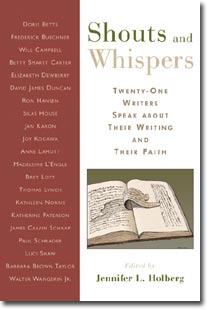
New Book on Faith & Writing entitled Shouts and Whispers


I haven't read it yet, but this looks good. I'm a big fan of a few of the included writers.


New Book Looks At Faith & Writing March 27, 2006

Just in time for next month's Festival of Faith & Writing at Calvin comes a book that features some of the best of past Festivals.

Shouts and Whispers: Twenty-One Writers Speak About Their Writing and Their Faith is edited by Calvin College professor of English Jennifer Holberg.

The book is published by Eerdmans and due out in mid-April (just prior to the 2006 Festival of Faith & Writing which is slated for April 20-22 and will feature Alice McDermott, Salman Rushdie, Marilynne Robinson, Walter Wangerin, Jr. and many more).

The new book includes interviews with such celebrated writers as Anne Lamott, Kathleen Norris and Paul Schrader and essays by such stalwarts as Frederick Buechner, Madeleine L'Engle, Bret Lott, Thomas Lynch, Katherine Paterson, Luci Shaw, Barbara Brown Taylor and Walter Wangerin Jr.

------------------------------------------------------------------
Thanks to Jeff Overstreet for the heads up on this one.

March 14, 2006

Purpose Statement and Values for Christian or Church Drama

Love them or hate them, church drama teams are most Christians' only exposure to live theatre. We've all seen them done poorly, but I believe that they can be done well. Here's a little statement of purpose and values I put forward at a large Orlando church when they asked me to head up their drama department.

PURPOSE STATEMENT

To encourage the exploration and expression of God’s truth through the theatre arts

VALUES

God is the first and greatest artist. The arts are not just a nice gift from God. They are an essential part of His character. As Creator, He is the master sculptor, choosing vivid colors and brilliant shapes in his works. We live in a sea of “purposeless” beauty; beauty that extends in scope from the vastness of galaxies and star systems to the miniscule order and structure of the vein of a leaf. If we served a God for whom the arts were merely a side note, the created order would have many more grays and unimpressive forms. As Son, He was a storyteller in the first degree. How much more pragmatic it would have been if Jesus had come equipped with a list of memorized steps for entering the Kingdom that He was ready to recite when asked. But instead he chose parables, metaphors, and often downright baffling statements to ensure his listeners would have to wrestle with His truth; that it would knock their hips out of joint, so that they might own that truth once they understood it. And finally, as Holy Spirit, He is the inspirer of the arts. Most obviously He inspired the literary collection of histories, stories, poems, and songs we know as the Scriptures. However, one could go so far as to say that He has a hand in the inspiration of all artists who are using their gifts to explore Truth. Therefore:

v The Church should be leading the way in their artistic quality because they have the greatest understanding of the first and greatest Artist.

v As a Church, we need to be modeling and equipping proper attitudes about the arts as a vital aspect of imitating God, both to artists and audiences.

v Theatre, and the appreciation thereof, need to be seen as worship.

v Performance and appreciation of so-called “secular” art can result in a better understanding of our God, our selves and our world.

Imitating the first and greatest artist needs no justification. With imitation of the creative nature of God as our purpose, we need not come up with further justification for the arts. They don’t need to “reach the lost” or “fill church seats”. The arts are a good thing to do, because God does them. Period. More often than not, other derivative benefits become evident: the building of community, the exploration of truth, the portrayal of ideas and concepts that cannot be captured in direct communication, however, there need not be tangible or measurable goals at the outset of an artistic journey.

Therefore:

v There should not have to be a measurable outcome to efforts put into artistic expression.

v Arts ministries should be giving all people, not just those talented enough to be in “productions”, the opportunity to explore the arts

v Theatre, sculpture, dance, poetry, literature and the appreciation thereof need to be seen as worship, as much as music.

The power of the arts is in the processing of abstract truths contained therein. If you’re reading the Cliff Notes to The Great Gatsby, you’re missing out on one of the most enriching journeys into truth that American literature has to offer. The power of the arts comes in the wrestling with ideas and concepts contained therein. Therefore, when we read the notes about a novel or explain the meaning of a song or dramatic piece we are short- circuiting that “wrestling” process. A famous French painter said “Once I understand a work of art, it is dead to me.” The joy and strength of the arts is the exploratory nature of them. If we say “Today we’re going to be talking about how sometimes communication in family can break down and it looks something like this…” and then follow it with a drama about communication breaking down, then we have short-circuited the process. There’s no reason to do the drama once you’ve revealed the purpose. But if people must connect the dots themselves, they will feel that much more “connected” with the ideas being presented. This concept, of letting the art speak for itself, requires faith. Faith in our audience; that they are not morons. Faith in our art; that it is powerful and accessible enough for people to enter into the journey. And faith in the Holy Spirit. The same Holy Spirit that worked in the artists, inspiring them to create the work of art, can and will work in the hearts of the audience to interpret the art. Therefore:

v Arts pieces should not be explained to the congregation.

v Dramas should stand alone to some extent and have the capacity to explore truth without a sermon to “finish the job” for them.

v Drama can complement the truths of the message, exploring abstractly what the message explores more directly, but the benefits of the abstract approach to truth are stifled by direct exposition about their meaning.

All endeavors, including artistic ones, will only please God if accomplished with love and community. St. Augustine states that God’s image was perfect in man before The Fall. And that sin shattered that image into a million pieces. We each now carry a broken portion of that image and when we work in community we’re allowed to put our pieces together and better reflect His image through us.

Therefore:

v While we will not proclaim the Discovery Theatre Arts Team to be a small group, we will endeavor to uphold each other in needs mental, emotional and spiritual.

v We commit to treating each other, and teams with which we work, with respect and compassion. We will be prompt, organized, prepared, and professional to the best of our ability.

March 01, 2006

Strong Words about Art - Bad News for Left Behind Films

"I'm grateful for and in dire need of whatever art can keep me awake and alive to the mystery, whatever keeps me paying attention, whatever reminds me that none of us (and no ideology) are possessors of the final say. Art that doesn't bear witness to the opaque, the mysterious, or even allow any ambiguity is propaganda at best and, at worst, a ministry of death, an exercise in sentimentalizing, self-congratulatory delusion."
-- David Dark, "Everyday Apocalypse"

February 07, 2006

Score one for the Arts!

Received this email from a fellow Christian School Theatre Director.

After the last ACSI convention we spoke for a few moments about some logistics, classroom lesson plans, etc. You suggested I watch the Uta Hagen DVDs. Well my school's library purchased the discs, and (after previewing and knowing when to hit mute!) I showed a majority of the dvds to my high school students. They fell in love ! It really resonated with them - and i was afraid it was going to be a little over their heads! I just wanted to thank you for the suggestion. We are starting work on Our Town for our Spring Production- a huge step for an administration that at one point suggested "Jill and Fred's Biblical Adventure." Praise God.

The DVD's of which she speaks are incredible. Uta Hagen, author of Respect for Acting and A Challenge for Actors, is a fiery, sage-like acting coach who both inspires and educates at every turn. The actor AND director will gain immensely from viewing these DVD's.


She also mentions Our Town. This is a play in which I wasn't that interested until I saw OT: Our Town, a fanstastic documentary about an inner city school producing this slice of life play set in a small country town. Check it out

I have to say, regarding my collegue's email, I am intrigued most by her mention of Jill and Fred's Biblical Adventure. Sounds like a wild ride!

November 24, 2005

Christian School Theatre Teachers Commiserate!

I recently attended my fifth ACSI (Association of Christian Schools International) Convention.

They are usually the source of intermittent boredom and frustration. Christian schools tend to be fifteen years behind the curve in cultural trend-spotting, and VERY lacking in content when it comes to the arts (especially the theatre arts.) This year, however, there were FIVE seminars that dealt specifically with my classes and areas of interest. Because I taught them.

I lead two seminars on Improv, one on God and the Arts, starting a Theatre Department at a Christian school, and one on Film Appreciation.

They were enormously successful and I met so many wonderful people. I connected with about two dozen similarly frustrated teachers and we all encouraged each other and shared ideas. Here's some outlines of a few of the seminars feel free to peruse.


God and the Arts
Imitating the First and Greatest Artist

I. Principles
A. God is the First and Greatest Artist (Gen 1)
o Father – Creator
o Son – Storyteller
o Spirit – Inspiration

B. Imitating the artistic God does not need justification.
o The arts don’t need to illustrate a sermon, fill seats, or “win the lost” to be
valuable.

C. All truth is God’s truth
o If something is true than God not only knows it, but had everything to do
with making it so.
o There is no rock we can pick up that will have under it something large
enough to eat our God.
o Common Grace – God can speak through non-Christians as well as Christians. Example: Nebuchadnezzar (Daniel 2)

II. So, What?
o The Christian Schools should be leading the way in their arts education because they have the greatest understanding of the first and greatest Artist.
o As Christian Educators, we need to be modeling and equipping students with proper attitudes about the arts as a vital aspect of imitating God, both as artists and audiences.
o Creating or appreciating creativity are acts of worship and should be valued as such.
o There should not have to be a measurable outcome to efforts put into artistic expression.
o Arts education should be giving all people the opportunity to explore the arts, not just the talented or those who have a “future in it.”
o We should be encouraging the exploration of Truth from a broader base than overtly “Christian art.”

III. Resources
www.artsandfaith.com – What started out as a collection of a dozen or so Christian Film Critics has expanded into the best and most active online discussion of the spiritual significance of Film, TV, Music, Novels, and much more.

The Liberated Imagination – Leland Ryken – A Wheaton professor who tackles the subject matter on a level you might find in an undergrad college course. Ryken is concise and erudite. It’s the most methodical look at these issues you’ll find.

Reflections on Water – Madeline L’Engle – Beloved children’s author, L’Engle employs a more left-brain approach faith and art.

Addicted to Mediocrity – Franky Schaeffer – Seasoned with a healthy dose of vitriol the son of Francis Schaeffer wrote this clever little book nearly 25 years ago, but its diagnosis of the Church’s attitude toward the arts is still spot-on. He has a number of cartoons poking fun at the attitudes of the church, and prophetically he has a cartoon of theme park called “Holy Land.”


Christian Theatre Arts Department;
Excellence with Nothing


I. Keeping it about the art
A. Just say “No” to skits
1. The difference between theatre as a tool and an art
2. Setting boundaries for your group (Don’t let other people’s needs dictate your departments focus.)
B. Just say “No” commercial training
1. We should be about getting students to fall in love with the art. Not the
trappings of the trade.

II. Cast a Vision
A. What are the primary values of your department?
1. Excellence
2. Exposure to various forms of the art
3. Audience education
4. Truth exploration / relevant issues
5. Acting and character analysis depth
6. Other?
B. How will your classes / productions reflect that?
C. Educational vs. Excellent – Sometimes one has to suffer for the other - YOU decide which is the focus of each effort
D. Have a “mantra” or “slogan” for your department

III. Classes
A. Start with one or two offerings. Expand down to increase interest.
B. Middle School students should be REQUIRED to take a short drama course,
then get them to fall in love with it.
C. Understand the “matrix” or master schedule at your school so you can make offerings that will be helpful
D. Dream up other electives you could teach that are nearby the performing arts (Improv, Speech / Debate, Creative Writing, Oral Interpretation, Exploring Films)

IV. Productions
A. Selecting a play
1. Pre-existing considerations
a. Space
b. Talent Pool (musical or non)
c. Past productions
2. “Safe” plays
a. Must maintain integrity to authors (DON’T CUT!!!)
b. Why do we want to be safe? God isn’t safe!
c. Legitimate considerations
· Audience distraction
· Endangering / Labelling Students
3. Trolling – look at what other companies with similar concerns are
producing. (Christian Colleges, Other Christian schools, Christian theatre
companies - Taproot, Lamb’s Players, Pacific Theatre)


B. Auditions / Casting
1. Give students the opportunity to be prepared, but leave enough room for
the “toe-dippers”
2. Remind students your choices are about the roles, not about talent
3. Use your school’s size to your advantage, go after kids who think
they’re not “drama people”
4. Don’t focus too much on being nice to everybody – cast the people that
make the most sense to cast. Use “personal” considerations when it’s a
toss-up.

C. Producing
1. Read-through – make it special – letters to chaacters
2. Contract – no athletics simultaneously
3. Rehearsing - 7 weeks - 3 3 4 4 4 5 5-(till 9)
4. Respect your actors’ time with your scheduling, try to group scenes
depending upon who’s in them
5. Double up all student positions. AD’s, Lights, Sound, Make-up, House Managers. Put a rookie with someone experienced.
6. Getting adult volunteers (ownership) – Don’t give them simple tasks to
make their life easier. Get them on the team! Props / Costumes / Cast
Care.

D. Promoting
1. Your show
a. Audiences matter to your kids and the future of your department
b. VIP tickets – Pastors, Headmaster and family, etc., give
discounts to faculty members.
c. Go after focused groups outside our school
*Other schools
*Assisted Living Facilities
*Groups for whom the content is relevant
d. Take good production pictures!!!
2. Department
a. T-Shirts
b. Your face – let them see you at shows, and congratulate you
c. EVERY Newsletter

VI. Obstacles
A. Space – Make a fantastic show, in a horrible space. Watch the parents respond
B. Budget - Use minimalism effectively
C. Ticket sales – Be sure you’re charging at least $6 adults / $4 students
Early on – sell out a show! Turn people away!!! No video!!
D. Goal – break even on your shows

VII. Brainstorming
A. Plays
B. Fundraisers – Christmas, Summer camps / Arts Boosters


Plays Worth Checking Out for Your School


Non-Musicals
All My Sons – Arthur Miller
The Foreigner – Larry Shue
Judgment at Nuremberg – Abby Mann
Harvey – Mary Chase
Dial M For Murder - Fredrick Knott
God’s Favorite – Neil Simon
Steel Magnolias – Robert Harling
Cyrano de Bergerac – Edmond Rostand
The Last Nights at Ballyhoo
Antigone – Jean Anouhl
Shadowlands
Afternoon of the Elves
Anne of Green Gables
Welcome to Justice – Dan Buck (write me) J
Talley’s Folley
Arsenic & Old Lace
Fools – Neil Simon
The Nerd – Larry Shue
The Diviners
Our Country’s Good
Beau Jest


Musicals
Big River
Smoke on the Mountain (small)
The Fantasticks (small)
Honk!
Godspell
The Music Man


Books

Respect for Acting – Uta Hagen (get the Video series as well)
Notes on Directing – Frank Hauser & Russel Reich
Truth in Comedy – Charna Halpern (improv book)


November 03, 2005

Films for the SOUL - Arts&Faith Top100 Spiritually Significant Films

The Arts & Faith website I mentioned a few posts ago has made public its new Top 100 Spiritually Significant Films.
Rank Title
1 Rosetta
2 The Passion of Joan of Arc
3 The Decalogue
4 The Diary of a Country Priest
5 Balthazar
6 The Word
7 The Gospel According to Matthew
8 Babette's Feast
9 The Son
10 To Live
11 The Apostle
12 Stalker
13 The Mission
14 The Seventh Seal
15 Dead Man Walking
16 A Man Escaped
17 Jesus of Montreal
18 Andrei Rublev
19 A Man for All Seasons
20 Sunrise: A Song of Two Humans
21 Chariots of Fire
22 Winter Light
23 The Miracle Maker
24 Day of Wrath
25 Wit
26 Sansho the Bailiff
27 Magnolia
28 Three Colors Trilogy
29 The Flowers of St. Francis
30 Wings of Desire
31 My Night at Maud's
32 La Promesse
33 Nostalghia
34 The Greatest Love
35 The Passion Of The Christ
36 Tender Mercies
37 Jesus of Nazareth
38 Ponette
39 The Apu Trilogy
40 Shadowlands
41 Wild Strawberries
42 Trial of Joan of Arc
43 Werckmeister Harmonies
44 The Mirror
45 Becket
46 The Sacrifice
47 Nazarin
48 To End All Wars
49 Schindler's List
50 Breaking The Waves
51 The Hiding Place
52 It's A Wonderful Life
53 Peter and Paul
54 The Big Kahuna
55 Dogville
56 Not of This World
57 Solaris
58 Yi Yi: A One and a Two
59 The Straight Story
60 Luther
61 A Taste of Cherry
62 The Gospel of John
63 Lilies of the Field
64 Tokyo Story
65 To Kill a Mockingbird
66 Hotel Rwanda
67 Dersu Uzala
68 Faust
69 Tales of Ugetsu
70 The Last Temptation Of Christ
71 Stevie
72 Millions
73 Open City
74 The Lord of the Rings trilogy
75 Rashomon
76 The Believer
77 Jean de Florette / Manon of the Spring
78 Late Spring
79 The Night Of The Hunter
80 Life is Beautiful
81 The Bicycle Thief
82 Close-Up
83 The Addiction
84 Cries and Whispers
85 The Wind Will Carry Us
86 The Virgin Spring
87 Pickpocket
88 Les Misérables
89 The Trip to Bountiful
90 2001: A Space Odyssey
91 Romero
92 The Shawshank Redemption
93 13 Conversations About One Thing
94 The Silence
95 An Autumn Afternoon
96 The Elephant Man
97 Amadeus
98 Eternal Sunshine of the Spotless Mind
99 In America
100 Unforgiven

I have seen it.
I have seen it and recommend it.
Be sure to check out the page itself, it has links to discussions of the films and places to rent or buy them.

October 19, 2005

My Play: An Update

For what its worth, I may have painted too bleak a picture of how my play was received.

From one of the producers:
Too bad we didn't find time to talk more about your script. There's lots to talk about, and yes - the producers who were there all felt it was the work of a real playwright. Not having talked with you at any length about the play or the responses you got, I'd be interested to know what led you to decide to simply set this one aside, "mourn it" and then move on to another. If that's primarily because the producers "passed" on your script, I'd challenge your perceptions/expectations of the symposium: as far as I know, not one play read at the event has yet led to a production by any of the participating companies - and we've heard a number of scripts that have been very fine. The Symp just isn't that kind of showcase: it isn't anything like an audition. Whether anyone there showed interest in producing your play should have no bearing whatsoever on your decisions regarding its future. More details if you'd like to pursue the question.

If you've got another idea for a play, or can come up with one, and really would rather launch in on Play Number Two rather than hang around Justice any longer, more power to you! There may be wisdom in that strategy - as I've been contemplating with my own writing.

But if you've still got rewriting in you, there's also real value in seeing your play staged. And don't you have the power to stage it, at your school, or within your church community perhaps, or?.... I think further revision could yield a perfectly stageworthy play that actors would be thrilled to be part of - nothing quite like originating a role - and audiences would be well served by.

If you're sick of it, or really do want to move forward, go for it. But I just wanted to make sure you didn't jump too quickly to the parachute station. My first play wasn't nearly as strong as yours: if I hadn't seen it onstage, would I have written as good a second play? Or third, or fourth, or tenth, or...? Who can say? But I wanted to raise the point

October 06, 2005

Christian Film Critics

I have long been a member of a message board that started as a collection of Christian Film Critics (of which I was one). Well after five years, two name changes, and a couple message board software switches, the group has grown into a vibrant, VERY active community of thoughtful Christian artists, critics, musicians, thinkers, and smart asses (of which I am one).

These people are the smartest people I know. They not only know movies like nobody's business, but they can discuss philosophy, theology, politics and music with amazing depth and clarity. The discussions and insights I've witnessed and been a part of their have developed my cinematic tastes, helped me choose a denomination that most suits my theology and personal tastes, and even convinced me to vote in the last presidential election. I was so frustraed by the candidates, I was ready to abstain, but ultimately didn't.

The movie and music tastes are a bit all over the map, but lean toward the more "culturally significant" works of art. You'll find more discussion of Tarkovsky and Bresson than you will about Speilberg or Lucas. But you'd be hard pressed to find a movie you can't get at least SOMEbody to talk to you about.

Check us out over there. Lurk, if you like, but feel free to jump into the discussion. You will certainly find a bevy of films to add to your MUST SEE list.

It's the first link over on my sidebar over there ---->
or just click here.


By the way, a handful of the most active members write for CTMovies. It's the movie branch of Christianity Today's website and it's intelligent writing and criticism.

September 03, 2005

THE VIDEO STORE OF THE SOUL

The following is a rewrite of an article I published a few years ago for Relevant Magazine. They asked for this version for their "college edition," which was handed out by the tens of thousands to college students on state campuses around the country.

If I had a video store, it would have one section: Movies. I’m not sure what effect that would have on business, but it would certainly reflect a lesson I’ve been learning and relearning from the moment I began thinking for myself. The lesson is this: Life is one category.

It seems simple enough, and hardly earth-shattering, but as I think about its implications, I find myself awe-struck by the possibilities of a life lived from this mindset. Have you read books in literature courses for which your English professor needs the help of a history professor to explain the historical context? Have you wandered aimlessly up and down the supermarket aisle designated “Sauces” looking desperately for soy sauce only to discover that it’s actually kept in the “Ethnic Foods” aisle? Are you left cold by church services or bands whose sole purpose is to feed your soul, and yet feel close to God watching the sun set, driving alone at night under a full moon, or even watching a Children’s movie? The reason for all these quandaries is the same: Life is one category.

GOD PENCILED IN
Oprah and Post-modernism in general, have given us the permission to talk about and even experience the spiritual without being thought of as deceived or insane. However, we’re still using a modernist “day timer” approach to where we think God can be encountered. We’ve placed God in a category that includes smiley men in suits on late-night cable and attending Mass with our parents when we go home for a visit. Unfortunately, many conclude that if God is not found in those places, he’s probably not found anywhere. In truth, if God was limited to those places, He’d be as bored there as you and I sometimes are.

LOOKING UNDER ROCKS
We’ve all heard that God is everywhere, but of course, the original intent of this adage was to make sure we weren’t beating up our little brother when our parents weren’t looking. However, not only is God everywhere, but he can be encountered in almost anything. If you buy into God as a creator (whether in six days or six million years), you’ll realize that the exploration of any part of his creation is ultimately the study of the master artist. Jay Kesler, the president of Taylor University used to say, “There is no rock under which you’ll discover something large enough to eat your God.” If what you’re experiencing is truth, God isn’t only aware of it; He made it so.

LET’S GET SPIRITUAL
Psychologist, Paul Tournier claimed that we have created an image of mankind that is, in essence a list: physical, emotional, mental and spiritual. Tournier would argue that spirituality should not be on that list but at the center of the other three. It is the source of our physical, mental and emotional output as well as the recipient of all input through those means. In other words, there is no way to be solely spiritual. Go ahead, be spiritual. Ready? ... One ... two ... three, go! What did you do? Trying to be spiritual away from the rest of our life is like trying to eat without any food or like trying to be a really good driver without ever going down the road. We get in and study the steering wheel and gauges, then we get out of the car and start walking down the road.

In truth, as impossible as it is to do something that is purely spiritual, it’s equally impossible to do anything that doesn’t contain some spiritual element. In the words of Evangline Paterson, “because God exists, everything has significance.” It is in the living out of our lives that our spirituality is exercised or neglected, nurtured or poisoned. Our spiritual battle is fought a million times a day in a million different ways. It is in the effort we put into our work, it’s in the music we hear on the radio, it’s in the speed with which we return our neighbor’s borrowed hedge trimmer.

A WELL-BALANCED SOUL DIET
What’s especially important to remember is that if everything has spiritual significance, there can be things that are detrimental to our spirit as well. Discernment needs to be used in what we’ll allow to have a significant impact on our souls. Whether it be films, friends, or books, too much of anything that is lacking in quality, morality or truth will begin to impact our spiritual selves negatively. Just as a diet of purely cotton candy and corn dogs will result in a physical decay of the body, a spiritual diet of teen blockbusters and time spent with “good time” friends will result in a decay of the soul.

WE LOVE OUR LABELS
Unfortunately, our long addiction to labels has stepped in at this point, and people over-concerned about what is “soul safe,” are whipping out the categories again. Opening a phone book, I can find Christian pharmacies, Christian art framing, Christian bakeries and here in my hometown someone has created a business concept out of a cheesy Christian T-shirt. The Lord’s Gym Health and Fitness Centers are dedicated to promoting “Fitness for Body & Soul” and offer classes such as Praise Dance, Body of Armor and Chariots of Fire Spin. Now, some might argue such businesses are a good model of stretching the barriers of our spiritual activity beyond Sunday morning. However, all they are doing is adding spiritual language to things that are naturally spiritual because they are part of the human experience God has created. We don’t need to label something Christian for it to be good and pure.

GOD’S COSMIC VIDEO STORE
All truth is God’s truth. If we are seeking out God in everything we do, He will inevitably show up. He doesn’t need labels or categories to find us, and we shouldn’t need them to find Him. Our categories have become the lazy person’s guide to spiritual health. We can’t get a dose of the God stuff at church, and we can’t avoid getting the God stuff outside the church. This can be both exciting and terrifying. It’s not supposed to be easy. Every experience, every person you meet and every choice you make is a part of the spiritual journey. In God’s cosmic video store there is one category: Spiritual. The good news is there are no late fees.