Showing posts with label improv. Show all posts

February 22, 2015

Watching People Laugh - It's Funny

I have a new observation about comedy.  People love to watch other people laugh.

There's little that causes genuine laughter like genuine laughter.  

You've seen it. When SNL actors start to laugh in the middle of a scene.  It's a mistake but it's supremely enjoyable.  We imagine the fun it must be to do what they are doing and we watch them enjoying entertaining us.  It's always funny. 


I'm currently directing The 39 Steps, a very funny parody of the spy-thriller.  And it's never funnier than when I notice the actors struggling to keep from laughing.  I don't encourage it. It can hurt the narrative to some degree. But when one actor does something hilarious and it takes the other off guard, it's hard not to enjoy the stifled giggles and covered smiles. 

I've experienced this quite a bit myself.  I have done a lot of improv shows and specifically, I have often hosted those shows.  And as a host I find that the audience is often watching me watch the scenes.  I don't think it's because I'm ridiculously good looking, I think it's because I'm their proxy on stage.  I am the first audience member and I am often cueing them about how to react to scenes.  When I laugh, they laugh, both at the players, and at me laughing at the players.  After shows, audience members often want to talk to me about moments they saw me laughing the hardest.  I've even heard them say "I love watching your reactions to the scenes as much as the scenes themselves."

I think there's an honesty to laughter.  Fake laughter is immediately recognizable and, I daresay, truly off-putting.  But someone caught up in a moment of hilarity is true, honest, vulnerable, and very human.  And, as I always tell my actors, there's nothing more compelling onstage than someone being fully human.  Laughter breaks through the barriers of self-consciousness, especially spontaneous laughter like in the clip above.  

Perhaps it's why we spend so much of our time trying to make each other laugh.  We are trying to spur an involuntary joy response.  Because we know it's real. 


January 29, 2008

Limerick Tuesday XIV

Before we dive in, some housekeeping and news.

    1. If you haven't already, fill out a survey. It's only 8 quick questions. It's over on my sidebar at the bottom
    2. I have been invited to become a part of Baylor's best (and only) Improv Comedy Team - The Guerrilla Troupe. The auditions were a lot of fun (and big). I'm not sure how I'll be involved. I'm hoping to host some shows and maybe show up for a few rehearsals to be able to get my "improv on". But I'm excited to be involved with these cool and funny people.
    3. I went to a concert at which Jon McLaughlin played and he was amazing. A genius on the ivories, he's like Ben Folds but less angry and more reflective. Oh, and he can sing. (No offense to Ben, I love Ben.) Anyway, check him out. And, by the way, if you are over 30 and want to feel really old, go to a concert on a college campus.


OKAY!!! LIMERICKS!!! - Post your entries on one topic or multiple topics in the comments section, and tell your friends to get involved. Go ahead, go to your myspace, facebook, or smoke signal fire and let your friends know about the coolest limerick contest on the web.

TOPICS
  • Baklava
  • Super Tuesday - The Superhero, NOT the political process
  • Smells at the Mall
  • Klaatu barada nikto!
  • Your favorite disciple

Go to it.

November 15, 2007

Getting Serious about Comedy

I'm fascinated by the funny. I always have been. Recently, I have had the opportunity to write about comedy in two different papers. The first, which I think is probably the best blog-type material is in a short reflection on postmodern humor, specifically, the anti-joke. Here's the anti-joke example I like the most:

A man meets his friend for lunch one day, only to discover that his friend has a huge, orange round head. He asks about it and the friend tells him the following story. "I was cleaning my attack the other day when I came across an antique bottle. When I opened it, a genie came out and told me he would grant me three wishes."
"That's amazing," his friend says.
"I know. So, I first wished for a million dollars. The genie closed his eyes for a moment, and then when he opened them, he told me to check my account. I pulled out my cell phone, called my bank and sure enough..."
"A million dollars?"
"That's right. So, then I asked for a beautiful woman to come into my life. And the next day, I met this gorgeous young woman at the coffee shop. Things have been going really well, and we're already talking about marriage."
"Wow! That's all so incredible. But I still don't understand about the..."
"Well, I'm getting to that. You see, when it came time for my third wish--and this is where I think I went wrong--I wished for a huge, orange round head."
Here is my reflection on why that and other anti-jokes (included in the reflection) are funny to the postmodern soul.

Clever Postmodern Title

Postmodern sensibility is particularly interested in self-reference. Value is given to any entity that is keenly aware of its own flaws or foibles and makes use of them to its benefit. For example, Scream, the horror movie, had characters ridiculing the formula common to the genre even as it participates in that formula. In recent literature, Dave Eggers’s A Heart-Breaking Work of Staggering Genius was not only self-referential in its title, but it opens with Rules and Suggestions for the Enjoyment of This Book which warns “The first three or four chapters are all some of you might want to bother with...The book thereafter is kind of uneven." This may hearken to the postmodern appreciation of authenticity. In such works, there is no illusion that what’s occurring is perfect or original. That authenticity is essentially post-modern. This trend is also labeled with the prefix “meta”, which roughly means “about itself.”

I am specifically interested in how this idea applies to humor. There is a trend within postmodernism to create jokes about jokes, or to comment on humor as it is being performed. For example, stand-up comedian Eddie Izzard will often pantomime writing in a small notepad after a “bit” doesn’t receive a laugh and mutters to himself “Never use that joke again.” His commentary then receives an enormous laugh. His best jokes are the ones about his own jokes. The following joke also exemplifies this idea, “Three people of different nationalities walk into the bar. Two of them say something smart, and the third one makes a mockery of his fellow countrymen by acting dumb.” It bases its humor on the shared knowledge of a joke-telling device, thereby deconstructing that device. This particular example adds the additional humor of pointing out a common practice of jokes to stereotype ethnic groups. This generic version of a joke demonstrates how absurd the practice is, and makes us laugh at our own nature. In essence this joke is “We are all racist jerks even when we think we’re being funny. Isn’t that hysterical?”

Connected to the meta-joke is the anti-joke. The meta-joke directly references the device of which it is a part. The anti-joke bases its humorous effect on marked diversion from the established trends of humor, and in so doing, it draws attention to them. Here are a few examples:

  • Yo Mama's so fat, that she was instructed by the doctor to go on a low carbohydrate, high protein diet to reduce the risk of heart disease or even a heart attack later in life.
  • Two cows are in a field. Suddenly, from behind a bush, a rabbit leaps out and runs away. One cow looks round a bit, eats some grass and then wanders off.
  • How many kangaroos does it take to fix a leaky water main? None, a kangaroo has neither the intelligence nor dexterity to do any kind of plumbing work. At best it could try to locate the source of the leek by jumping around, but even then it would be hard pushed to actually do anything about it.
  • Two men are walking down the street...
    I forget the punch-line, but your mother's a whore.

Douglass Mann, professor of philosophy at the University of Windsor says, “Anything fast, image-centered (as opposed to using written text), without a linear narrative, anything that shocks or alienates the traditions in its field, can be seen as having a postmodernist flavour.” Clearly, anti-jokes are “alienating the tradition” of joke telling. They diverge from the expected course in a way that makes us look at the course we were expecting to take objectively.

The SECOND opportunity to write on comedy comes in the form of a big-ass paper on Commedia dell'arte, a masked Italian comedy style that involves improvisation. I entered the paper in a little contest of sorts here on campus, and it was selected to be read at a forum tonight. (And I get a $100 prize) . I think getting paid to read a paper makes me a professional geek. (Especially if the paper has the word cacophony in it).

September 03, 2006

Oh, to Become Famous for Watching!


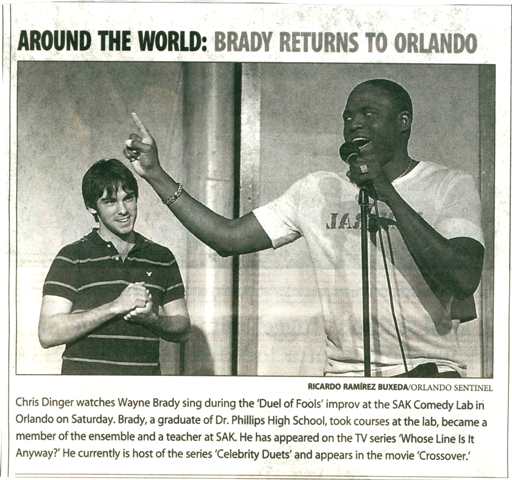
This clipping from the Orlando Sentinel shows Wayne Brady appearing at Sak Comedy Lab (Sat. Sept. 2nd). He just popped in and jumped into the show. The SAKtor (as they are called) behind him is Chris Dinger, a student of mine, who has become a good friend. I called him to make fun of him for failing to appear in a photo in which he is perfoming alongside Brady (which he did often that night), but rather for being captured looking like a star-struck wannabee. A couple observations:
  1. Why didn't this happen 24 hours earlier in the show I hosted?!
  2. I believe the paper flipped this photo for some reason because the word on Brady's shirt is backwards.
  3. If I'm ever in a photo with someone who is respected in a field I consider my own, I hope a verb other than "watches" is used to describe my role in the event.

August 11, 2006

SAK performances in late summer

Just a heads up, I'll be perfroming at SAK Comedy Lab tonight (Aug. 11, 2006), next week (18th) and Sept. 1st. All my shows are at 8PM.

The Spet 1st show is with buddy and ex-student Chris Dinger.

Hope to see you there. If I spot you in the audience, I'll make sure you get some free tootsie rolls.

January 29, 2006

My Professional Improv Debut


Roughly a dozen years ago, I sat in a show at SAK comedy lab in Orlando, FL as a junior in high school and I thought to myself, “I will be doing this one day.” The thought was not so much a life ambition, just acknowledgement that my sense of humor and penchant for smart ass remarks would almost certainly lead me here.

Several years later, I started a comedy improv team at Taylor University (Upland, IN) called the Rice Pilaf Players. We sort of trained ourselves, but eventually found a rhythm and became quite successful. The group has continued to this day. I later started improv teams at Gordon College (Wenham, MA), First Baptist Church of Orlando, and finally at the high school where I now teach (Orlando, FL).

When I first moved down here, I checked out SAK, but picked the far less reputable Lost & Found Club (Longwood, FL), which crumbled soon after my departure. (a coincidence…? Probably.) It was a lousy little show, and sometimes degraded into hostile barprov (improv at a bar, where the only reason people notice you is because microphones make you the loudest one in the room). But I learned a ton.

Once I got to the school where teach now, I met two students Chris Dinger and Benji Hurlburt. They were rising up through the ranks of SAK and always encouraged me to join the fun over there.

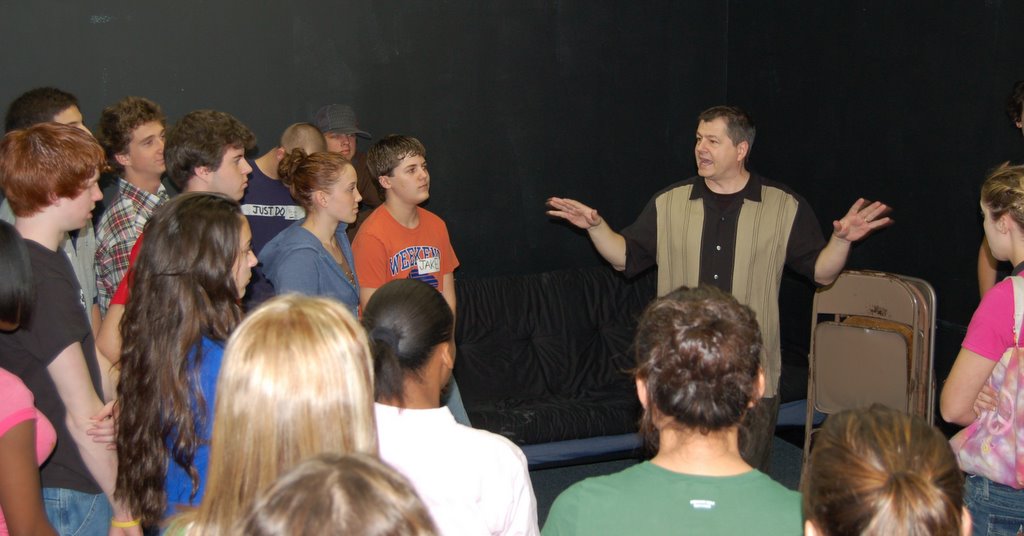
I signed up my teenage improv minions in the High School League at SAK, and while there for a high school show, Dave Russel (The director of SAK -see photo at left) asked me if I’d be interested in hosting shows. Well, I was.


My first show went pretty well. I had a very supportive cast made up of:


Chris Dinger my ex-student


Richard Paul - an old chum from my Lost & Found days


John (my school’s High School League instructor)


Francisco The night I showed to SAK those many years ago (4) and played with the LabRats, it was the Fran-man's first night too.


Mark Baratelli New to me in real life, but I'd been to his blog and new he was funny.


Charles Frierman -
Who I’ve performed with before at a private gig


It was my first night, and there was only one person I hadn’t either work-shopped or performed with before. It could not have been more comfortable.

And it’s official…. I’m a HOST! I’m even listed as such on the SAK website! Click on my name, go ahead. There’s nothing there yet, but you can click on it! When I know my regular show schedule I'll post it here.

December 12, 2005

SAK Comedy Lab's High School League

SAK Comedy Lab has begun a league for high schoolers and my school (Pine Castle) is one of the innaugural groups. This Saturday was the SHOWCASE for teams that have been training with SAK instructors all semester. It wasn't scored, but we certainly won in terms of audience support!


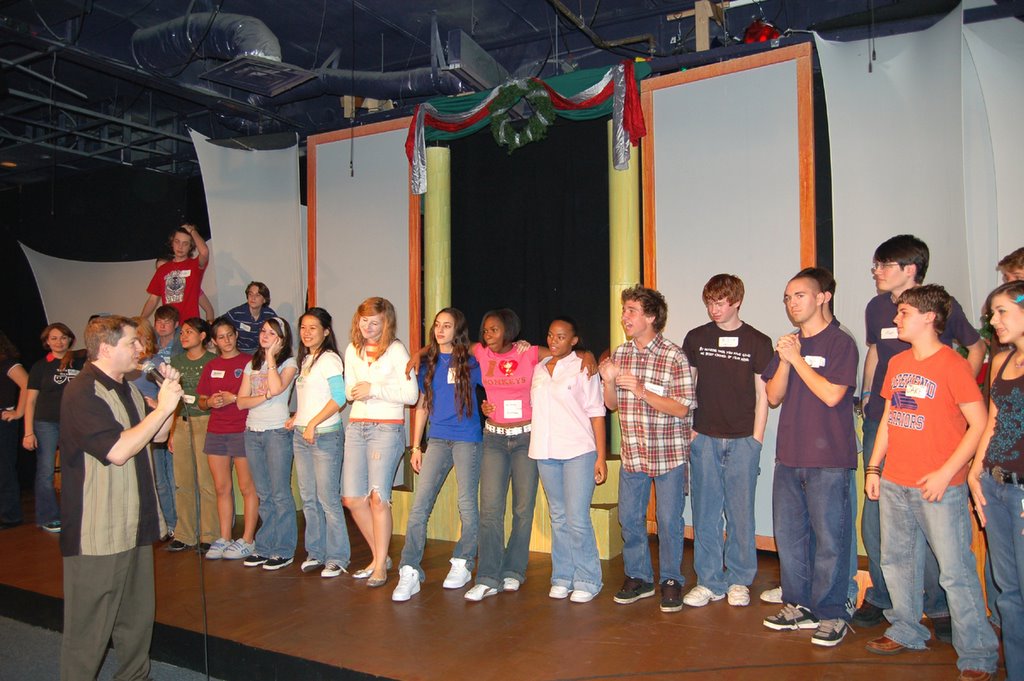
Here, the host of the show and Artistic Director of SAK, Dave Russell, looks over his minions.


David Banks, Mark Lee and Garret Hovarter perform in the best scene of the show. They are... Team PLANKTON!


Dave teaches high schoolers how to fly.


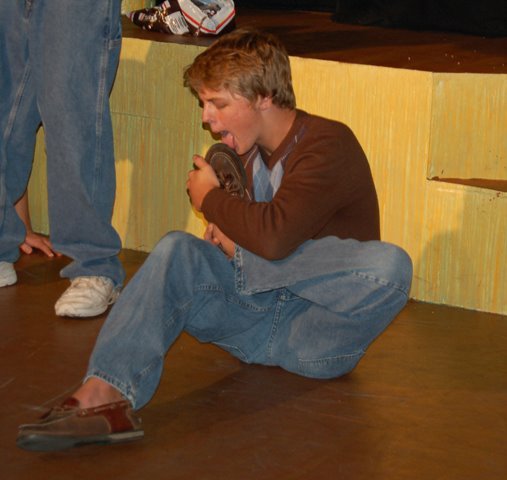
"mmmmmm... Loafers!" Derrick Smith.


"If they want to worship me, I say LET them worship me." Jake Link narrates a Slide Show scene with AC Caraker, Shaun Stoffer, Lani Suarez, and Derrick Smith.

November 24, 2005

Christian School Theatre Teachers Commiserate!

I recently attended my fifth ACSI (Association of Christian Schools International) Convention.

They are usually the source of intermittent boredom and frustration. Christian schools tend to be fifteen years behind the curve in cultural trend-spotting, and VERY lacking in content when it comes to the arts (especially the theatre arts.) This year, however, there were FIVE seminars that dealt specifically with my classes and areas of interest. Because I taught them.

I lead two seminars on Improv, one on God and the Arts, starting a Theatre Department at a Christian school, and one on Film Appreciation.

They were enormously successful and I met so many wonderful people. I connected with about two dozen similarly frustrated teachers and we all encouraged each other and shared ideas. Here's some outlines of a few of the seminars feel free to peruse.


God and the Arts
Imitating the First and Greatest Artist

I. Principles
A. God is the First and Greatest Artist (Gen 1)
o Father – Creator
o Son – Storyteller
o Spirit – Inspiration

B. Imitating the artistic God does not need justification.
o The arts don’t need to illustrate a sermon, fill seats, or “win the lost” to be
valuable.

C. All truth is God’s truth
o If something is true than God not only knows it, but had everything to do
with making it so.
o There is no rock we can pick up that will have under it something large
enough to eat our God.
o Common Grace – God can speak through non-Christians as well as Christians. Example: Nebuchadnezzar (Daniel 2)

II. So, What?
o The Christian Schools should be leading the way in their arts education because they have the greatest understanding of the first and greatest Artist.
o As Christian Educators, we need to be modeling and equipping students with proper attitudes about the arts as a vital aspect of imitating God, both as artists and audiences.
o Creating or appreciating creativity are acts of worship and should be valued as such.
o There should not have to be a measurable outcome to efforts put into artistic expression.
o Arts education should be giving all people the opportunity to explore the arts, not just the talented or those who have a “future in it.”
o We should be encouraging the exploration of Truth from a broader base than overtly “Christian art.”

III. Resources
www.artsandfaith.com – What started out as a collection of a dozen or so Christian Film Critics has expanded into the best and most active online discussion of the spiritual significance of Film, TV, Music, Novels, and much more.

The Liberated Imagination – Leland Ryken – A Wheaton professor who tackles the subject matter on a level you might find in an undergrad college course. Ryken is concise and erudite. It’s the most methodical look at these issues you’ll find.

Reflections on Water – Madeline L’Engle – Beloved children’s author, L’Engle employs a more left-brain approach faith and art.

Addicted to Mediocrity – Franky Schaeffer – Seasoned with a healthy dose of vitriol the son of Francis Schaeffer wrote this clever little book nearly 25 years ago, but its diagnosis of the Church’s attitude toward the arts is still spot-on. He has a number of cartoons poking fun at the attitudes of the church, and prophetically he has a cartoon of theme park called “Holy Land.”


Christian Theatre Arts Department;
Excellence with Nothing


I. Keeping it about the art
A. Just say “No” to skits
1. The difference between theatre as a tool and an art
2. Setting boundaries for your group (Don’t let other people’s needs dictate your departments focus.)
B. Just say “No” commercial training
1. We should be about getting students to fall in love with the art. Not the
trappings of the trade.

II. Cast a Vision
A. What are the primary values of your department?
1. Excellence
2. Exposure to various forms of the art
3. Audience education
4. Truth exploration / relevant issues
5. Acting and character analysis depth
6. Other?
B. How will your classes / productions reflect that?
C. Educational vs. Excellent – Sometimes one has to suffer for the other - YOU decide which is the focus of each effort
D. Have a “mantra” or “slogan” for your department

III. Classes
A. Start with one or two offerings. Expand down to increase interest.
B. Middle School students should be REQUIRED to take a short drama course,
then get them to fall in love with it.
C. Understand the “matrix” or master schedule at your school so you can make offerings that will be helpful
D. Dream up other electives you could teach that are nearby the performing arts (Improv, Speech / Debate, Creative Writing, Oral Interpretation, Exploring Films)

IV. Productions
A. Selecting a play
1. Pre-existing considerations
a. Space
b. Talent Pool (musical or non)
c. Past productions
2. “Safe” plays
a. Must maintain integrity to authors (DON’T CUT!!!)
b. Why do we want to be safe? God isn’t safe!
c. Legitimate considerations
· Audience distraction
· Endangering / Labelling Students
3. Trolling – look at what other companies with similar concerns are
producing. (Christian Colleges, Other Christian schools, Christian theatre
companies - Taproot, Lamb’s Players, Pacific Theatre)


B. Auditions / Casting
1. Give students the opportunity to be prepared, but leave enough room for
the “toe-dippers”
2. Remind students your choices are about the roles, not about talent
3. Use your school’s size to your advantage, go after kids who think
they’re not “drama people”
4. Don’t focus too much on being nice to everybody – cast the people that
make the most sense to cast. Use “personal” considerations when it’s a
toss-up.

C. Producing
1. Read-through – make it special – letters to chaacters
2. Contract – no athletics simultaneously
3. Rehearsing - 7 weeks - 3 3 4 4 4 5 5-(till 9)
4. Respect your actors’ time with your scheduling, try to group scenes
depending upon who’s in them
5. Double up all student positions. AD’s, Lights, Sound, Make-up, House Managers. Put a rookie with someone experienced.
6. Getting adult volunteers (ownership) – Don’t give them simple tasks to
make their life easier. Get them on the team! Props / Costumes / Cast
Care.

D. Promoting
1. Your show
a. Audiences matter to your kids and the future of your department
b. VIP tickets – Pastors, Headmaster and family, etc., give
discounts to faculty members.
c. Go after focused groups outside our school
*Other schools
*Assisted Living Facilities
*Groups for whom the content is relevant
d. Take good production pictures!!!
2. Department
a. T-Shirts
b. Your face – let them see you at shows, and congratulate you
c. EVERY Newsletter

VI. Obstacles
A. Space – Make a fantastic show, in a horrible space. Watch the parents respond
B. Budget - Use minimalism effectively
C. Ticket sales – Be sure you’re charging at least $6 adults / $4 students
Early on – sell out a show! Turn people away!!! No video!!
D. Goal – break even on your shows

VII. Brainstorming
A. Plays
B. Fundraisers – Christmas, Summer camps / Arts Boosters


Plays Worth Checking Out for Your School


Non-Musicals
All My Sons – Arthur Miller
The Foreigner – Larry Shue
Judgment at Nuremberg – Abby Mann
Harvey – Mary Chase
Dial M For Murder - Fredrick Knott
God’s Favorite – Neil Simon
Steel Magnolias – Robert Harling
Cyrano de Bergerac – Edmond Rostand
The Last Nights at Ballyhoo
Antigone – Jean Anouhl
Shadowlands
Afternoon of the Elves
Anne of Green Gables
Welcome to Justice – Dan Buck (write me) J
Talley’s Folley
Arsenic & Old Lace
Fools – Neil Simon
The Nerd – Larry Shue
The Diviners
Our Country’s Good
Beau Jest


Musicals
Big River
Smoke on the Mountain (small)
The Fantasticks (small)
Honk!
Godspell
The Music Man


Books

Respect for Acting – Uta Hagen (get the Video series as well)
Notes on Directing – Frank Hauser & Russel Reich
Truth in Comedy – Charna Halpern (improv book)